
15 KiB
Recurrent Networks | RNNs1
Why would we want Recurrent Networks?
To deal with sequence related jobs of arbitrary length.
In fact they can deal with inputs of varying length while being fast and memory efficient.
While autoregressive models always needs to analyse all past inputs
(or a window of most recent ones), at each computation,
RNNs don't, making them a great tool when the situation permits it.
A bit of History2
In order to predict the future, we need
information of the past. This is the idea behind
RNNs for
predicting the next item in a sequence.
While it has been attempted to accomplish this prediction
through the use of memoryless models, they didn't hold
up to expectations and had several limitations
such as the dimension of the "past" window.
Shortcomings of previous attempts2
- The
context windowwas small, thus themodelcouldn't use distant past dependencies - Some tried to count words, but it doesn't preserve meaning
- Some tried to make the
context windowbigger but this caused words to be considered differently based on their position, making it impossible to reuseweightsfor same words.
RNNs3
The idea behind RNNs is to add memory
as a hidden-state. This helps the model to
"remember" things for "long time", but since it
is noisy, the best we can do is
to infer its probability distribution, doable only
for:
While these models are stochastic, technically the a posteriori probability ditstibution is
deterministic.
Since we can think of RNNs hidden state equivalent to a a posteriori probability ditstibution, they are deterministic
Neurons with Memory4
While in normal NNs we have no memory, these
neurons have a hidden-state, \vec{h} ,
which is fed back to the neuron itself.
The formula of this hidden-state is:
\vec{h}_t = f_{W}(\vec{x}_t, \vec{h}_{t-1})
In other words, The hidden-state is influenced by
a function modified by weights and
dependent by current inputs and preious step
hidden-states.
For example, let's say we use a \tanh
activation-function:
\vec{h}_t = \tanh(
    W_{h, h}^T \vec{h}_{t-1} + W_{x, h}^T \vec{x}_{t}
)
And the output becomes:
\vec{\bar{y}}_t = W_{h, y}^T \vec{h}_{t}
Note
Different RNNs configurations
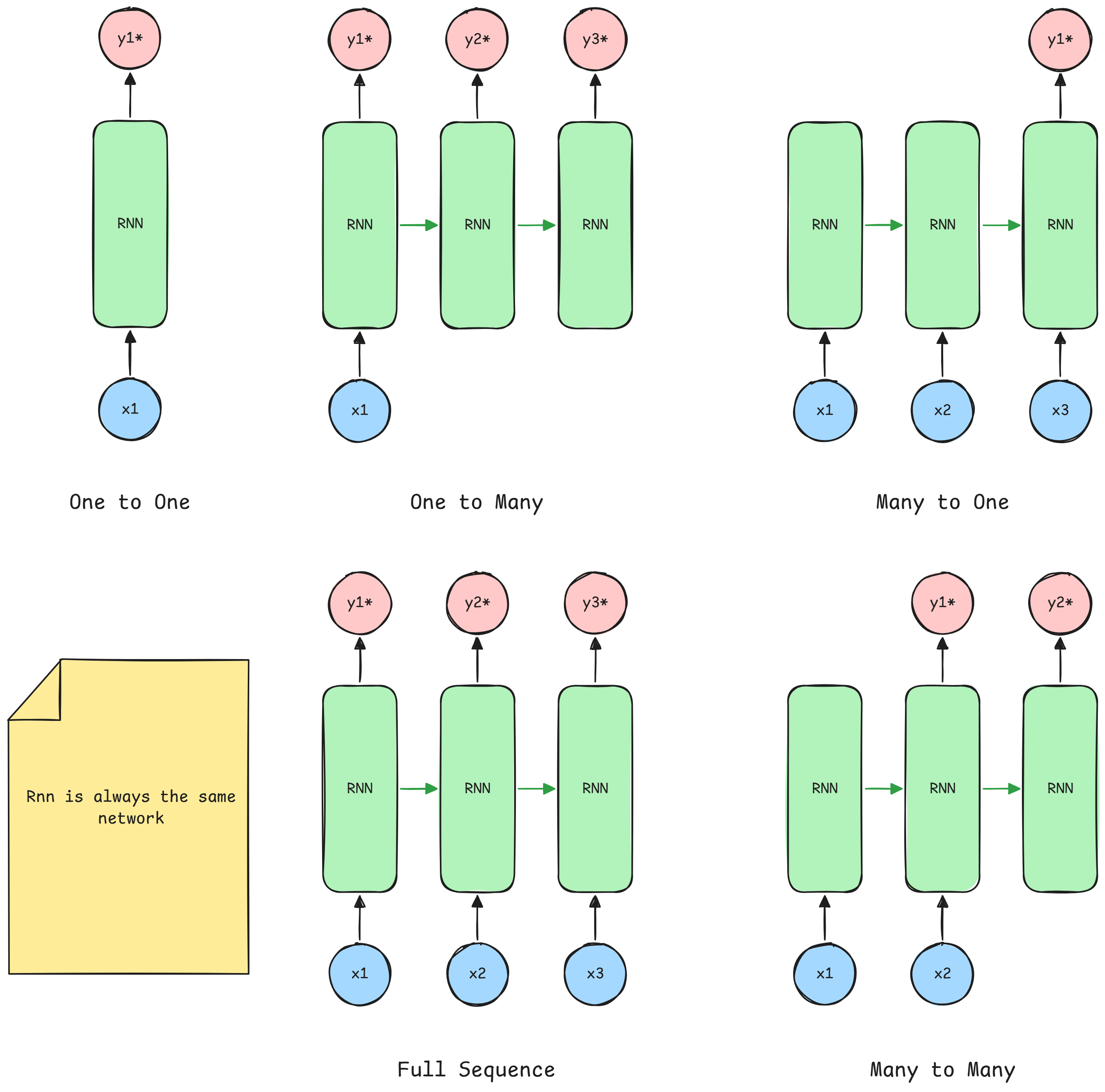
Providing initial-states for the hidden-states6
- Specify
initial-statesof allunits - Specify
initial-statesfor a subset ofunits - Specify
initial-statesfor the same subset ofunitsfor eachtimestep(Which is the most naural way to model sequential data)
In other words, it depends on how you need to model data according to your sequence.
Teaching signals for RNNs7
- Specify desired final activity for all
units - Specify desired final activity for all
unitsofr the last fewsteps- This is good to learn
attractors - Makes it easy to add extra error derivatives
- This is good to learn
- Speficfy the desired activity of a subset of
units- The other
unitswill be eitherinputsorhidden-states, as we fixed these
- The other
In other words, it depends on which kind of output you need to be produced.
for example, a sentimental analysis would need to have just one output, while
a seq2seq job would require a full sequence.
Transforming Data for RNNs
Since RNNs need vectors, the ideal way to transform inputs into vectors is either
having 1-hot encoding over whole words or transform them into tokens and then
1-hot encode them.
While this is may be enough, there's a better way where we transform each 1-hot encoded vector into a learned vector of fixed size (usually of smaller dimensions) during the embedding phase.
To better understand this, imagine a vocabulary of either 16K words or Tokens. we would have 16K dimensions for each vector, which is massive. Instead, by embedding it into 256 dimensions we can save both time and space complexity.
RNNs Training
Since RNNs can be considered a deep-layered
NN, then we firstly train the model
over the sequence and then backpropagate,
keeping track of the training stack, adding
derivatives along time-steps
Caution
If you have big gradients, remember to
clipthem
The thing is that is difficult to train
RNNs on
long-range dependencies because the
gradient will either vanish or explode8
Mitigating training problems in RNNs
In order to mitigate these gradient problems that impairs our network ability to gain valuable information over long term dependencies, we have these solutions:
- LSTM:
Make the model out of little modules crafted to keep values for long time - Hessian Free Optimizers:
Use optimizers that can see the gradient direction over smaller curvatures - Echo State Networks9:
The idea is to use asparsely connected large untrained networkto keep track of inputs for long time, while eventually be forgotten, and have atrained readout networkthat converts theechooutput into something usable - Good Initialization and Momentum:
Same thing as before, but we learn all connections using momentum
Warning
long-range dependenciesare more difficult to learn thanshort-rangeones because of the gradient problem.
Gated Cells
These are neurons that can be controlled to make
them learn or forget chosen pieces of information
Caution
With chosen we intend choosing from the
hyperspace, so it's not really precise.
High Level Scheme
The point of an RNN cell is to be able to modify its internal state.
As for the image, this can be implemented by having gates (AND operations) to read, write and keep (remember) pieces of information in the memory.
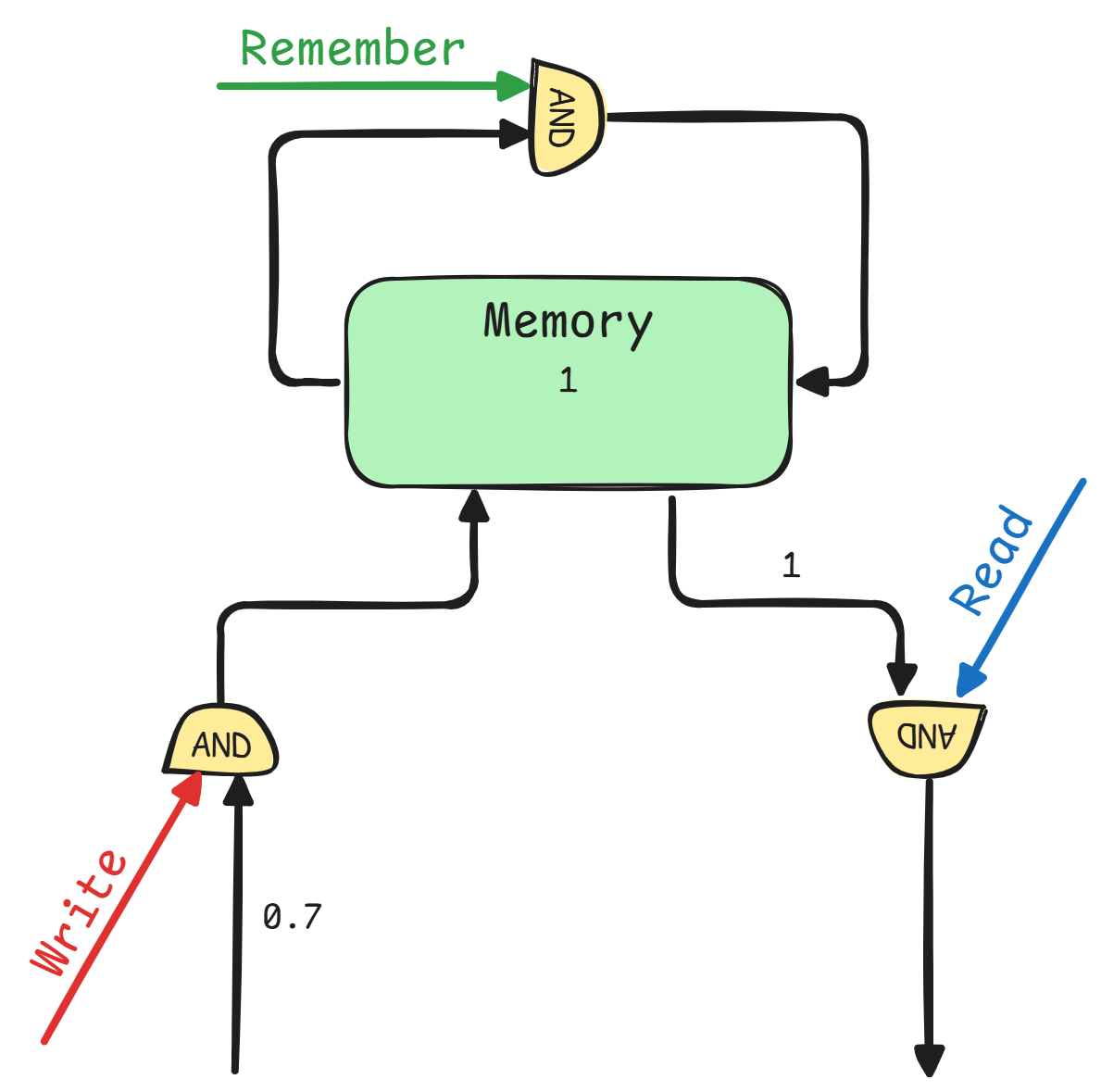
Even though this is a high level and simplistic architecture, it gives a rough idea of how to implement it.
-
First of all, instead of using
ANDgates, we can substitute with an elementwise multiplication. -
Secondly we can implement an elementwise addition to take combine a new written element with a past one
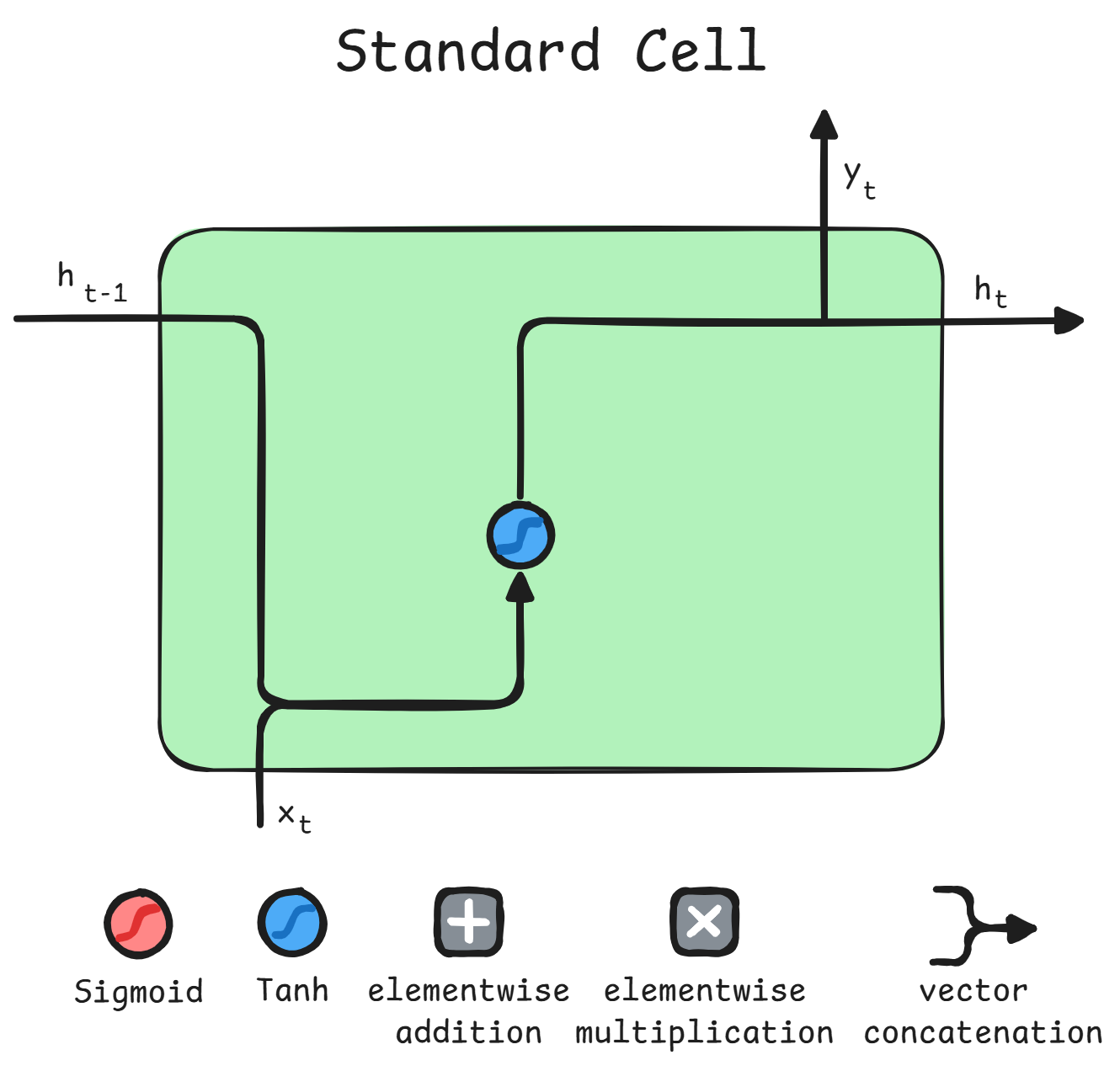
Standard RNN Cell
This is the most simple type of implementation. Here all signals are set to 1
Long Short Term Memory | LSTM1011
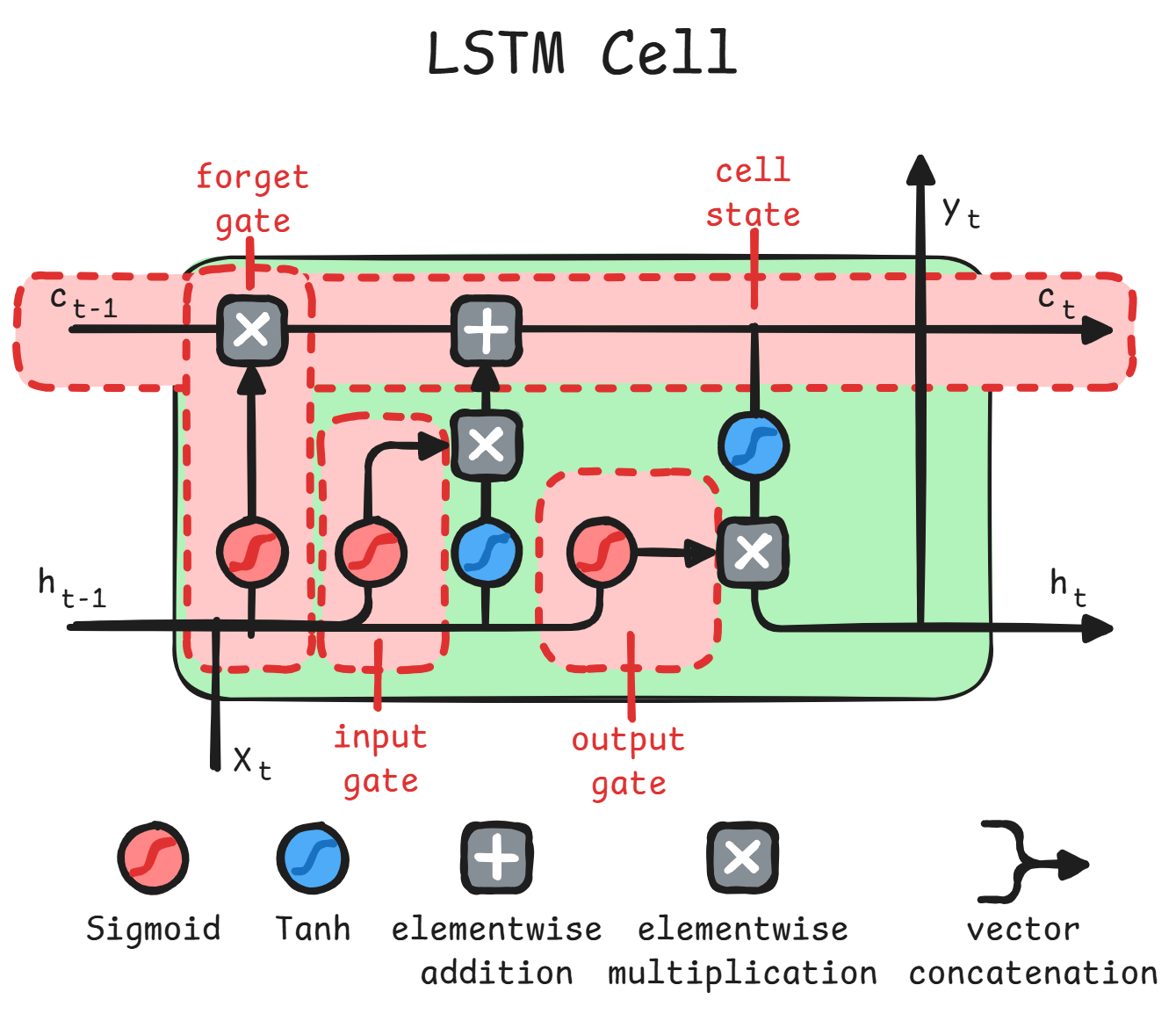
This cell has a separate signal, namely the
cell-state,
which controls gates of this cells, always
initialized to 1.
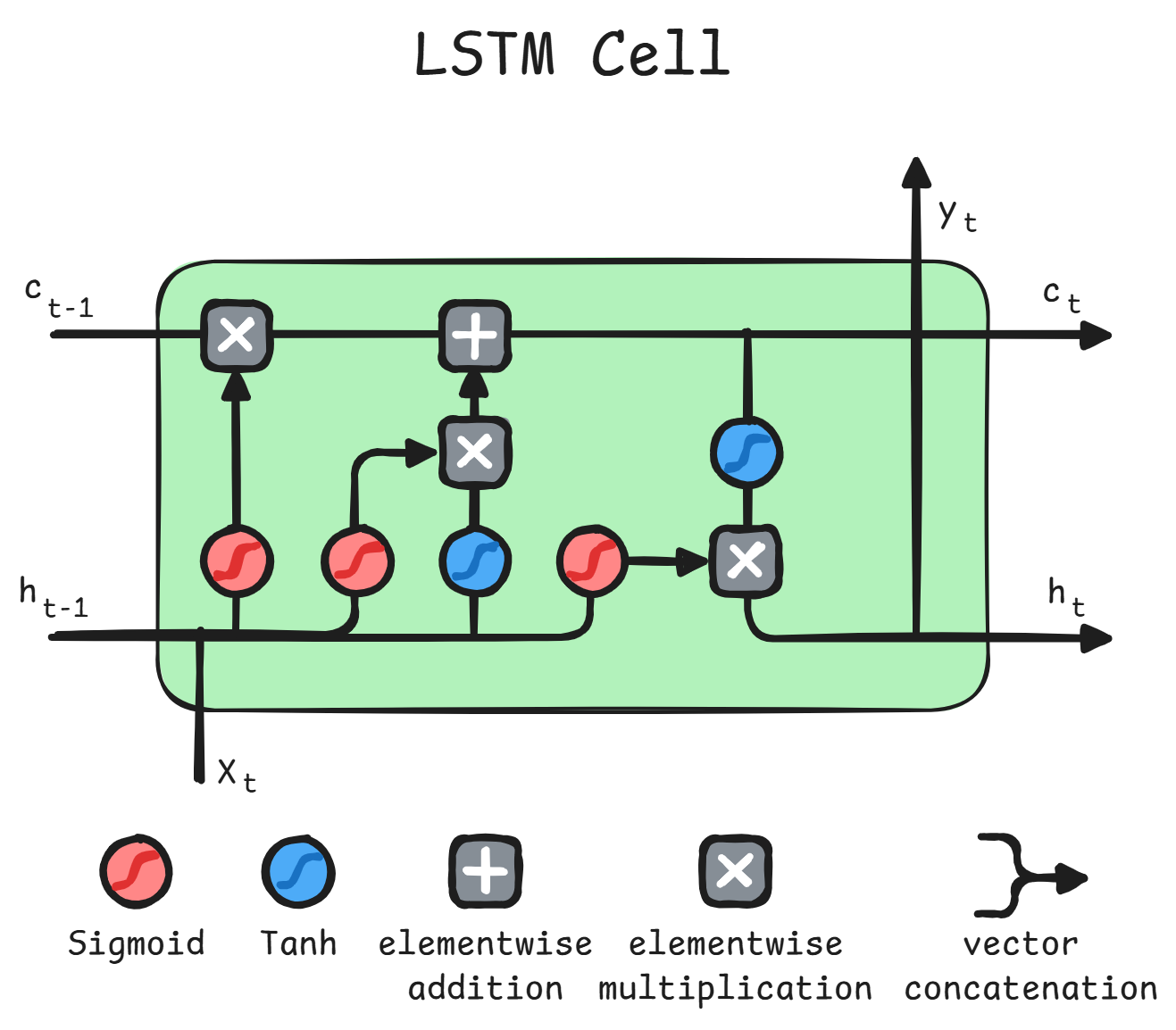
As for the image, we can identify a keep (or forget) gate, write gate and read gate.
-
Forget Gate:
The previousread state(h_{t-1}) concatenated withinput(x_{t}) is what controls how much of theprevious cell statekeeps being remembered. Since it has values\in [0, 1], it has been called forget gate -
Input Gate:
It is controlled by asigmoidwith the same inputs as the forget gate, but with different weights. It regulates how much of thetanhof same inputs goes into the cell state.tanhhere has an advantage over thesigmoidfor the value as it admits values\in [-1, 1] -
Output Gate:
It is controlled by asigmoidwith the same inputs as the previous gates, but different weights. It regulates how much of thetanhof thecurrent state cellgoes over theoutput
Note
Wwill be weights associated with\vec{x}andUwith\vec{h}.The
cell-statehas the same dimension as thehidden-state
\odotis the Hadamard Product, also called the pointwise product
Forget Gate | Keep Gate
This gate controls the cell-state:
\hat{c}_{t} = \sigma \left(
    U_fh_{t-1} + W_fx_t + b_f
\right) \odot c_{t-1}
The closer the result of \sigma is to 0, the more
the cell-state will forget that value, and opposite
for values closer to 1.
Input Gate | Write Gate
controls how much of the input gets into the
cell-state
c_{t} = \left(
    \sigma \left(
        U_ih_{t-1} + W_ix_t + b_i
    \right) \odot \tanh \left(
        U_ch_{t-1} + W_cx_t + b_c
    \right)
\right) + \hat{c}_{t}
The results of \tanh are new pieces of
information. The higher the \sigma_i, the higher
the importance given to that info.
Note
The
forget gateand theinput-gateare 2 phases of theupdate-phase.
Output Gate | Read Gate
Controls how much of the
hidden-state is forwarded
h_{t} = \tanh (c_{t}) \odot \sigma \left(
    U_oh_{t-1} + W_ox_t + b_o
\right)
This produces the new hidden-state.
Notice that
the info comes from the cell-state,
gated by the input and previous-hidden-state
Here the backpropagation of the gradient is way
simpler for the cell-states as they require only
elementwise multiplications
GRU1213
It is another type of gated-cell, but,
on the contrary of LSTM-cells,
it doesn't have a separate cell-state, but only
the hidden-state, while keeping
similar performances to LSTM.
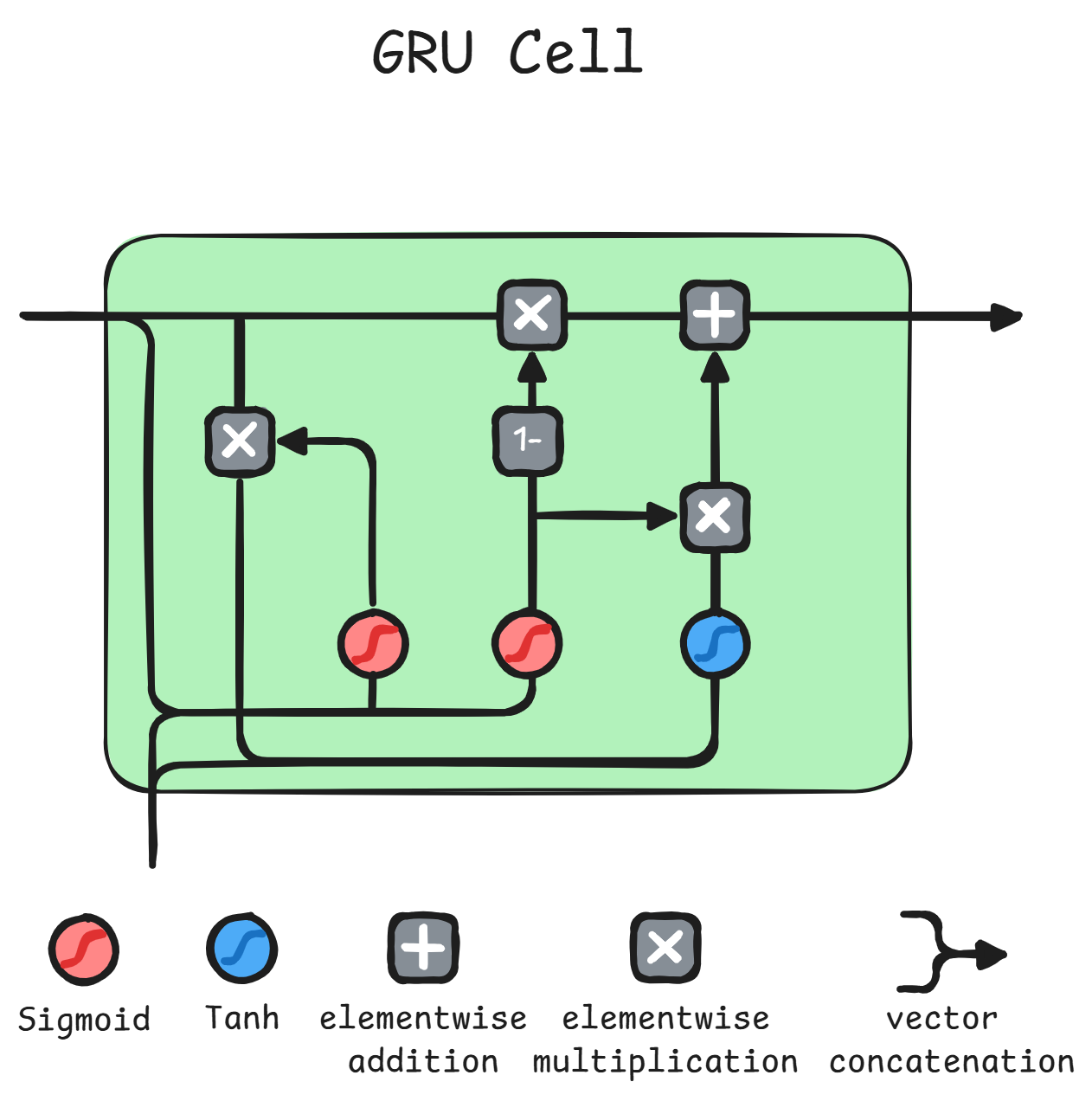
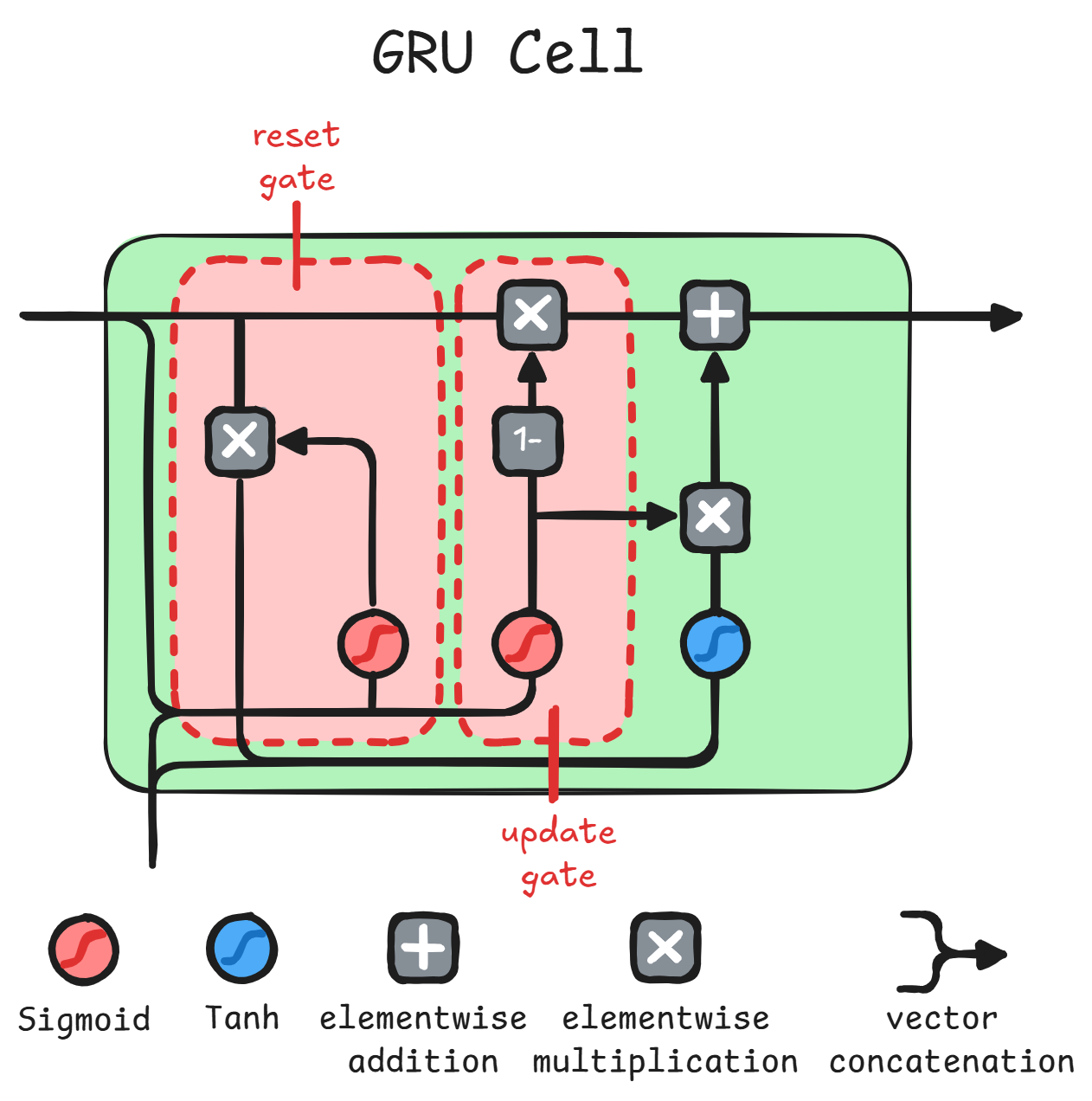
As for the image, we have only 2 gates:
- Reset Gate:
Tells us how much of the old information should pass with the input. It is controlled by theold stateand theinput. - Update Gate:
Tells us how much of the old info will be kept and how much of the new info will be learnt. It is controlled by a concatenation of theoutput of reset gateand theinputpassing from atanh.
Note
GRUdoesn't have anyoutput-gateandh_0 = 0
Update Gate
This gate unifies forget gate and input gate
\begin{aligned}

    \hat{h}_t &= \left(
        1 - \sigma \left(
            U_z h_{t-1} + W_z x_{t} + b_z
        \right)
    \, \right) \odot h_{t-1}
\end{aligned}
Reset Gate
This is what breaks the information flow from the
previous hidden-state.
\begin{aligned}
    \bar{h}_t &= \sigma\left(
            U_r h_{t-1} + W_r x_{t} + b_r
        \right) \odot h_{t-1}
\end{aligned}
New hidden-state
\begin{aligned}
    h_t = \hat{h}_t + (\sigma \left(
        U_z h_{t-1} + W_z x_{t} + b_z
    \right) \odot \tanh \left(
        U_h \bar{h}_t + W_h x_t + b_h
    \right))
\end{aligned}
Tip
There's no clear winner between
GRUandLSTM, so try them both, however the former is easier to compute
Bi-LSTM1415
We implement 2 networks, one that takes hidden states coming from computing info over in order, while the other one taking hidden states in reverse order.
Then we take outputs from both networks and compute attention and other operations, such as
softmax and linear ones, to get the output.
In this way we gain info coming from both directions of a sequence.
Applications16
- Music Generation
- Sentiment Classification
- Machine Translation
- Attention Mechanisms
Pros, Cons and Quirks
References
- ai-master.gitbooks.io
- stanford.edu - CS224d-Lecture8
- deepimagesent
- introduction-to-rnns
- implementing-a-language-model-rnn-with-python-numpy-and-theano
- rnn-effectiveness
- Understanding-LSTMs
-
Vito Walter Anelli | Deep Learning Material 2024/2025 | PDF 8 ↩︎
-
Vito Walter Anelli | Deep Learning Material 2024/2025 | PDF 8 pg. 11 to 20 ↩︎
-
Vito Walter Anelli | Deep Learning Material 2024/2025 | PDF 8 pg. 21 to 22 ↩︎
-
Vito Walter Anelli | Deep Learning Material 2024/2025 | PDF 8 pg. 25 ↩︎
-
Vito Walter Anelli | Deep Learning Material 2024/2025 | PDF 8 pg. 43 to 47 ↩︎
-
Vito Walter Anelli | Deep Learning Material 2024/2025 | PDF 8 pg. 50 ↩︎
-
Vito Walter Anelli | Deep Learning Material 2024/2025 | PDF 8 pg. 51 ↩︎
-
Vito Walter Anelli | Deep Learning Material 2024/2025 | PDF 8 pg. 69 to 87 ↩︎
-
Vito Walter Anelli | Deep Learning Material 2024/2025 | PDF 8 pg. 91 to 112 ↩︎
-
Vito Walter Anelli | Deep Learning Material 2024/2025 | PDF 8 pg. 113 to 118 ↩︎
-
Vito Walter Anelli | Deep Learning Material 2024/2025 | PDF 8 pg. 127 to 136 ↩︎
-
Vito Walter Anelli | Deep Learning Material 2024/2025 | PDF 8 pg. 119 to 126 ↩︎