
5.8 KiB
Transformers
Block Components
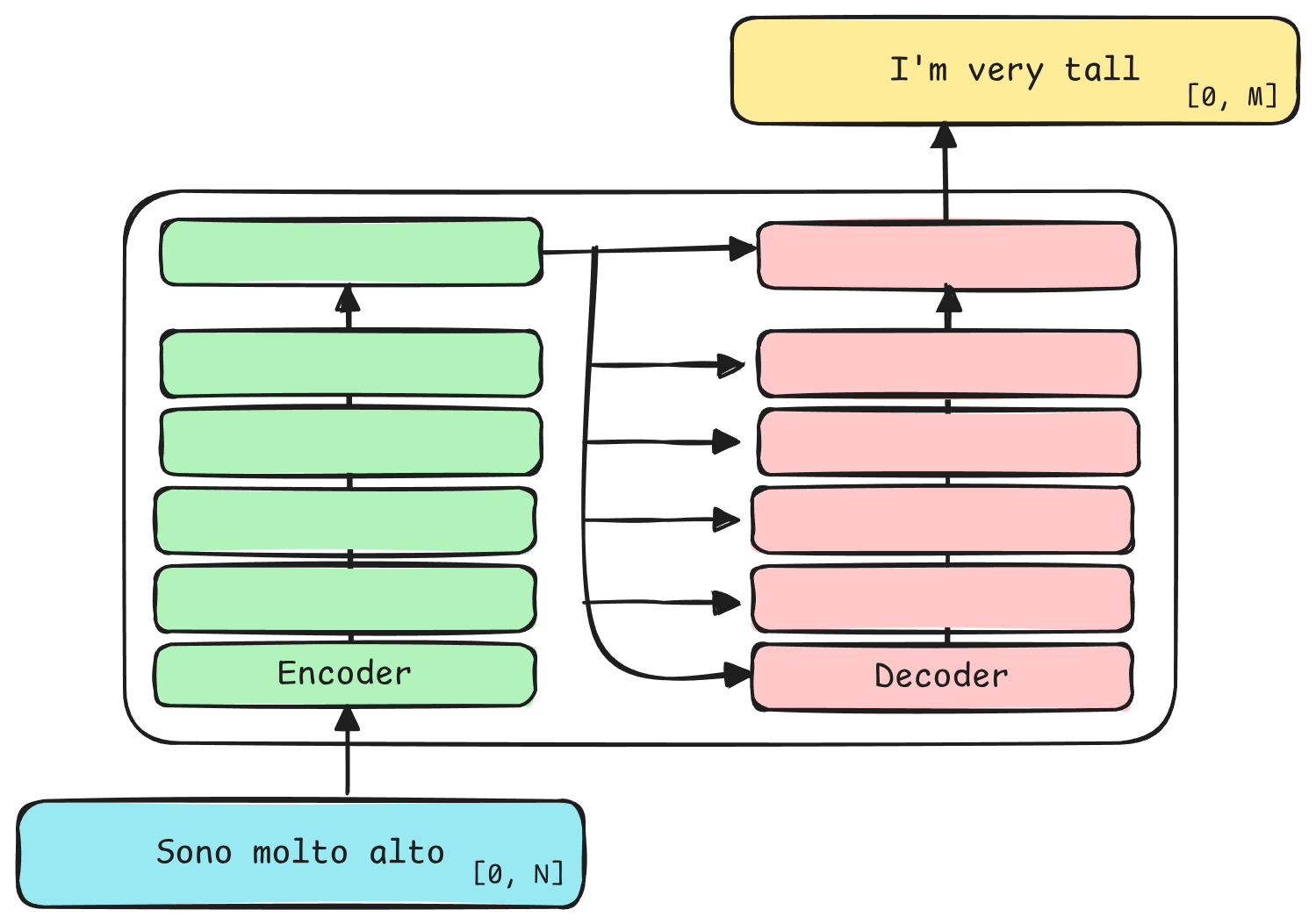
The idea is that each Transformer block is made of the same number of Encoders and
Decoders
Note
Input and output are vectors of fixed size with padding
Before feeding our input, we split and embed each word into a fixed vector size. This size depends on the length of longest sentence in our training set
Embedder
While this is not a real component per se, this is the first phase before even coming
to the first encoder and decoder.
Here we transform each word of the input into an embedding and add a vector to account for position. This positional encoding can either be learnt or can follow this formula:
- Even size:
\text{positional\_encoding}_{
    (position, 2\text{size})
} = \sin\left(
        \frac{
            pos
        }{
            10000^{
                \frac{
                    2\text{size}
                }{
                    \text{model\_depth}
                }
            }
        }
    \right)
- Odd size:
\text{positional\_encoding}_{
    (position, 2\text{size} + 1)
} = \cos\left(
        \frac{
            pos
        }{
            10000^{
                \frac{
                    2\text{size}
                }{
                    \text{model\_depth}
                }
            }
        }
    \right)
Encoder
Caution
Weights are not shared between
encodersordecoders
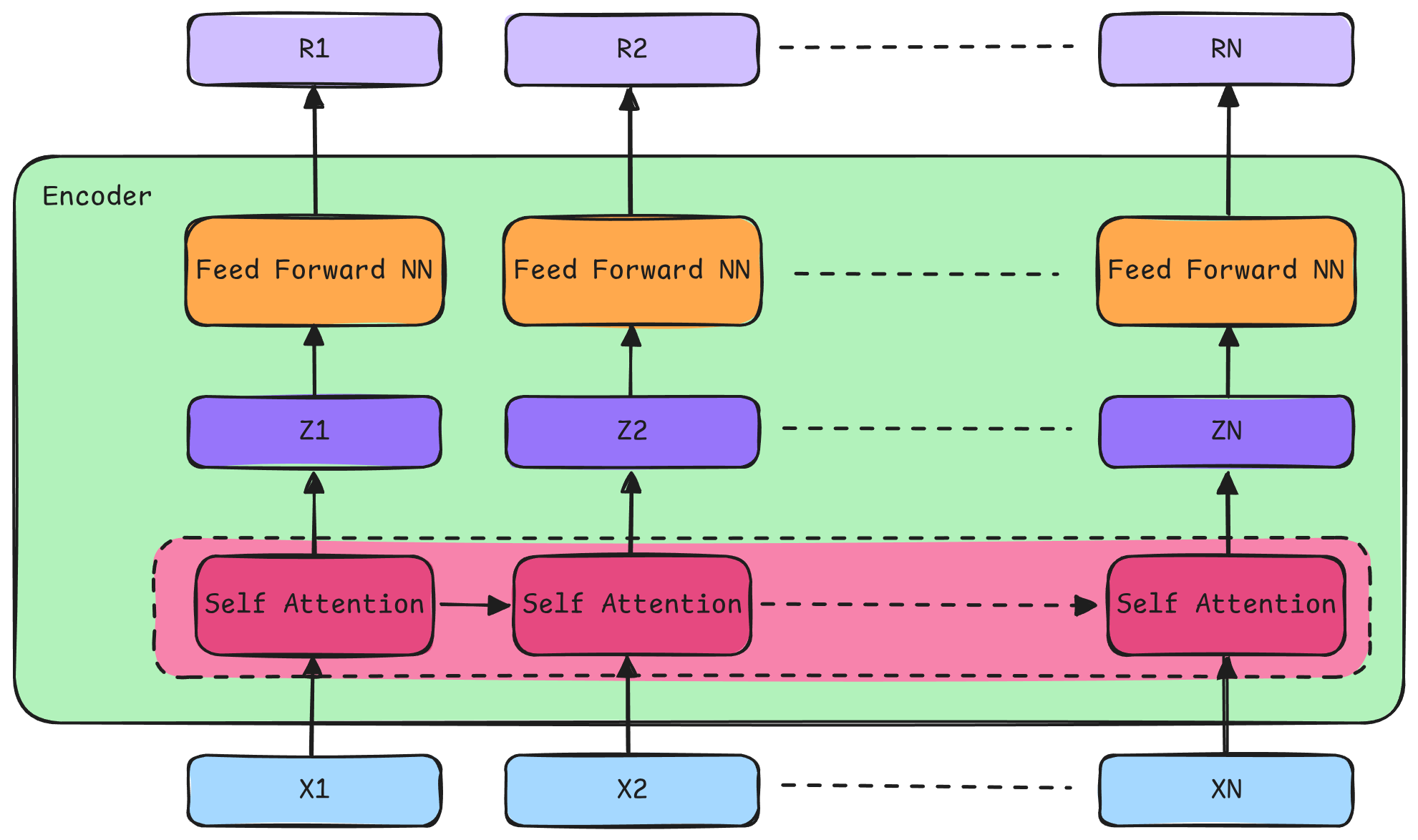
Each phase happens for each word. In other words, if our embed size is 512, we have 512 Self Attentions and
512 Feed Forward NN per encoder
Encoder Self Attention
Warning
This step is the most expensive one as it involves many computations
Self Attention is a step in which each token gets the knowledge of previous ones.
During this step, we produce 3 vectors that are usually smaller, for example 64 instead of 512:
- Queries
\rightarrow q_{i} - Keys
\rightarrow k_{i} - Values
\rightarrow v_{i}
We use these values to compute a score that will tell us how much to focus on certain parts of the sentence while encoding a token
In order to compute the final encoding we do these for each encoding word i:
- Compute score for each word
j:\text{score}_{j} = q_{i} \cdot k_{j} - Divide each score by the square root of the size of these helping vectors:
\text{score}_{j} = \frac{\text{score}_{j}}{\sqrt{\text{size}}} - Compute softmax of all scores
- Multiply softmax each score per its value:
\text{score}_{j} = \text{score}_{j} \cdot v_{j} - Sum them all:
\text{encoding}_{i} = \sum_{j}^{N} \text{score}_{j}
Note
These steps will be done with matrices, not in this sequential way
Multi-Headed Attention
Instead of doing the Attention operation once, we do it more times, by having differente matrices to produce our helping vectors.
This produces N encodings for each token, or N matrices of encodings.
The trick here is to concatenate all encoding matrices and learn a new weight matrix that will combine them
Residuals
In order no to lose some information along the path, after each Feed Forward and Self-Attention
we add inputs to each sublayer outputs and we do a Layer Normalization
Encoder Feed Forward NN
Tip
This step is mostly parallel as there's no dependency between neighbour vectors
Decoder
Note
The decoding phase is slower than the encoding one, as it is sequential, producing a token for each iteration. However it can be sped up by producing several tokerns at once
After the last Encoder has produced its output, K and V vectors, these are then used by
all Decoders during their self attention step, meaning they are shared among all Decoders.
All Decoders steps are then repeated until we get a <eos> token which will tell the decoder to stop.
Decoder Self Attention
It's almost the same as in the encoding phase, though here, since we have no future outputs, we can only take into
account only previous tokens, by setting future ones to -inf.
Moreover, here the Key and Values Mappings come from the encoder pase, while the
Queue Mapping is learnt here.
Final Steps
Linear Layer
Produces a vector of logits, one per each known words.
Softmax Layer
We then score these logits over a SoftMax to get probabilities. We then take the highest one, usually.
If we implement Temperature, though, we can take some tokens that are less probable, but having less predictability and
have some results that feel more natural.
Training a Transformer
Known Transformers
BERT (Bidirectional Encoder Representations from Transformers)
Differently from other Transformers, it uses only Encoder blocks.
It can be used as a classifier and can be fine tuned.
The fine tuning happens by masking input and predict the masked word:
- 15% of total words in input are masked
- 80% will become a
[masked]token - 10% will become random words
- 10% will remain unchanged
- 80% will become a
Bert tasks
- Classification
- Fine Tuning
- 2 sentences tasks
- Are they paraphrases?
- Does one sentence follow from this other one?
- Feature Extraction: "Allows us to extract feature to use in our model
GPT-2
Differently from other Transformers, it uses only Decoder blocks.
Since it has no encoders, GPT-2 takes outputs and append them to the original input. This is called autoregression.
This, however, limits GPT-2 on how to learn context on input because of masking.
During evaluation, GPT-2 does not recompute V, K and Q for previous tokens, but hold on their previosu values.